This is Creator Economy Law, a newsletter dedicated to exploring and analyzing the legal issues surrounding the creator economy—creators, influencers, brands, and platforms. If you enjoy what you’re reading, share with friends, and invite them to subscribe using the button above and share using #CreatorEconomyLaw.
It’s been a hot minute since the last issue (about 5 months, to be exact)! If this if your first issue since you subscribed… welcome to the fun!
Since the last issue, I’m excited to share a Creator Economy Law brand refresh* and approach to how I deliver some aspects of the newsletter. But, more on that in the coming weeks.
This is a shorter issue as I ramp back up, so enjoy!
*Didn’t you know? A new brand is all the range right now! Just ask ConvertKit → Soon to be Kit.

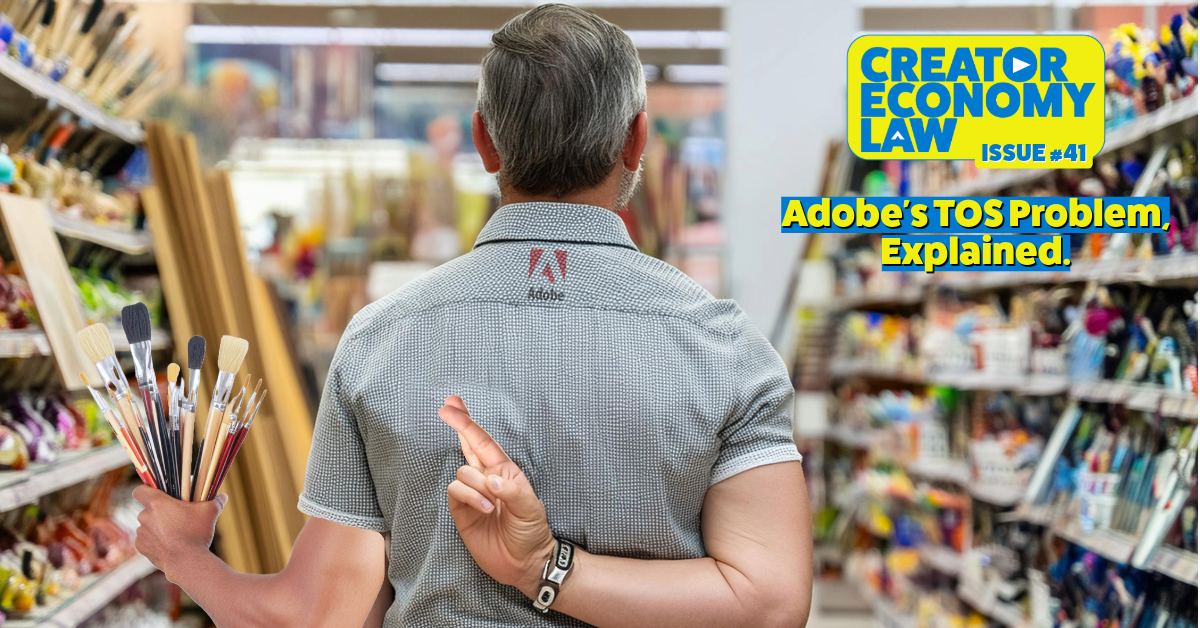
🔥 Adobe’s TOS Debacle 🔥
Main Takeaways:
- Industry standard language used in SaaS terms of service (“TOS”) agreements is coming under more scrutiny, especially language around the scope of data use permissions.
- Online service providers should be closing examining their terms with legal, product, CX, and comms teams to check for clarity, updating as necessary. Consider preparing a set of comms should they come under scrutiny.
Background on Adobe’s TOS:
Adobe last updated their TOS in February 2024, but for some reason they recently pushed an in-app notification to users about a change in how the company reviews content. The key clauses Adobe noted were being changed are Sections 2.2 and 4.1. Keep this in mind…
On June 4th, Scott Wetterschneider, an Austin-based digital sculptor, posted on X with a screenshot of the in-app message which noted, in part, that Adobe‘s TOS updates “clarified that we may access your content through both automated and manual methods, such as content review.”
Enter: the backlash. Google Trends show that over the last 7 days, the search queries for “adobe new terms of service” increased 3,700%.
Adobe published a blog post on Thursday, June 6th, responding to the criticism, but they ignore issues with Section 4.2, “Licenses to Your Content,” which is causing the most concern among creative communities across the entire Adobe product ecosystem.
Solely for the purposes of operating or improving the Services and Software, you grant us a non-exclusive, worldwide, royalty-free sublicensable, license, to use, reproduce, publicly display, distribute, modify, create derivative works based on, publicly perform, and translate the Content. For example, we may sublicense our right to the Content to our service providers or to other users to allow the Services and Software to operate as intended, such as enabling you to share photos with others. Separately, section 4.6 (Feedback) below covers any Feedback that you provide to us.
In a world sensitive to how generative AI technologies are being developed, the phrasing “operating or improving the Services” can mean a wide range of things, including improving algorithms and models. In order to provide a gen AI model, is it reasonable to interpret these phrases as a consent or license grant to use a customer’s data to improve a model or related technologies that power AI tools?
But, Adobe isn’t alone here in this type of phrasing for TOS. It’s practically industry standard. For example, Microsoft‘s Data Protection Addendum—which overrides any other customer contracts—includes similar language under an expanded definition of what “to provide” products and services means. I just led a roundtable in Nashville on the topic, so check out my slide deck.
I’ve written previously about the buried privacy setting within Adobe Creative Cloud that requires users opt-out (instead of a more consumer-friendly opt-in) of having their data, or extracts of their data, used to improve technologies like Adobe Sensei.
It’s worth noting that Adobe’s blog post only references a commitment to not using customer data to improve Firefly, which is arguably fair because the only way in which tools like background removal or image recognition improve is through continued content analysis. I’ve made similar comparisons to YouTube‘s ability to analyze content to improve search, automatic captions, etc.
Now What?
At the end of the day, reputable service providers (like Adobe and Microsoft) have a vested interest in keeping customers by not exploiting the data that is stored, processed, or run through their systems.
But, customers also need to fully understand the scope of access to and use of their data when using a cloud-based or internet-connected product/service.
📈 Rise of the Creator-Investor 💸
Influencers are taking on the role of investor through innovative brand partnerships, redefining the traditional influencer-brand relationship. 🤔 Curious how?
I got you covered with my latest article diving into a recent video from TikTok influencer Alix Earle and her new investment in poppi, the viral soda brand.
Read the full article over at Passionfruit.
☕️ Support this newsletter! Buy me a coffee if you love the content I produce. ✌🏻

Content creators are silently rewriting the innovation and strategy rule book for a multitude of established companies, particularly in the consumer goods and services industries. By changing how consumers search for and use products, creators are: 1) driving demand for increasingly specialized products and services; 2) accelerating product life cycles; and 3) changing what customers actually value.
Leveraging the Creator Economy. Harvard Business Review published the article “How Your Business Should Tap Into the Creator Economy” that proposes four strategies for leveraging the creator economy. Authors Rebecca Karp, Carolyn Fu, and Simon Friis do a fantastic job of proposing some methods of defining creators, influencers, and the impact small creators have on the entire ecosystem.
Protecting Kids Online. Political pressure and media coverage continues to swirl around all the various activities taking place across the creator economy to protect kids online. But, what does that actually mean?
- CNN‘s Faith Karimi published an intriguing exposé into now-adult social media babies.
- Vox‘s A.W. Ohlheiser compiled a nice explainer on Congress’s online child safety bill (KOSA).
- The laws keep coming, too. New York passed a law, pending signature by Gov. Kathy Hochul, that aims to protect children from “addictive” social media algorithm. Kat Tenbarge covers it all over at NBC News.
Posting to Opt Out. Thanks to Social Media Today and Andrew Hutchinson for breaking down what should be obvious: you can’t opt-out of a platform’s TOS simply by posting.Speaking of opting out… Cara is an anti-Instagram social media app that is gaining popularity among artists for touting a supposedly “anti-AI” stance on using user data. But in reality, I’d argue there will still be automated processing of content on any platform because human review simply isn’t practical, and a platform needs to implement such technical measures to take advantage of certain legal safe harbors. 🤨

Bringing Creator Economy Law to Berkeley Law
I’m pinching myself that my paper proposal for Creator Economy Law was accepted and I’ll be presenting at the the Intellectual Property Scholars Conference (IPSC), hosted by Berkeley Center for Law & Technology (BCLT) and University of California, Berkeley – School of Law.
I’ll be in the Berkeley, CA, area from August 7-10th, so let me know if you’ll be there, too!
Building a Podcast Guest Release… from Scratch with Google Gemini Advanced
I did a livestream on YouTube recently… because what else do you do on Saturday night besides draft a podcast guest release from scratch using Google Gemini Advanced 🤣
Watch the video. Check out the Podcast Release template.

Stopping by Top Shelf Creator
Last week, I had fun chatting about gen AI in the creator economy with Kabrina Ashley on her podcast, Top Shelf Creator.
In the episode, I break down two categories for how creators should be thinking about using (and not using) these tools:
🎨 Creativity – Use of these tools in the creative process is a minefield for creators. Incorrectly incorporating generative AI tools that replace human authorship with synthetic output can turn into a risky long game.
⚙️ Operations – Use of these tools for process and business operations is rapidly becoming the most common that we’re seeing. Whether it’s Kajabi’s tools to brainstorm, Riverside.fm to auto-generate clips, or Anthropic models to write low-value (from an IP perspective) copy, creators still need to understand where the line should be drawn.
Listen to the episode as we dive into even more fun topics and legal issues creator businesses MUST be aware of! For example, do you own your audience list? 🤔

I’m hitting you up with some K-Pop fun this week! A new boyband, TWS, has some really great EPs and singles released. Oh Mymy : 7s is hands down one of my new favorites and the music video doesn’t disappoint!
Watch on YouTube or Apple Music.

☕️ Support this newsletter! Buy me a coffee if you love the content I produce. ✌🏻
Not Legal Advice. This newsletter is published solely for educational and entertainment value. Nothing in this newsletter should be considered legal advice. If you need legal assistance or have specific questions, you should consult a licensed attorney in your jurisdiction. I am not your attorney. Do not share any information in the comments you should keep confidential.
Personal Opinions. The opinions and thoughts shared in this newsletter are my own, and not those of my employer or any of the third parties mentioned or linked to in this newsletter. No affiliation or endorsement is implied or otherwise intended with third parties that are referenced or linked.
Enjoying this? Share with someone you think might be interested! If this was forwarded to you, jump over to LinkedIn and subscribe for free.